
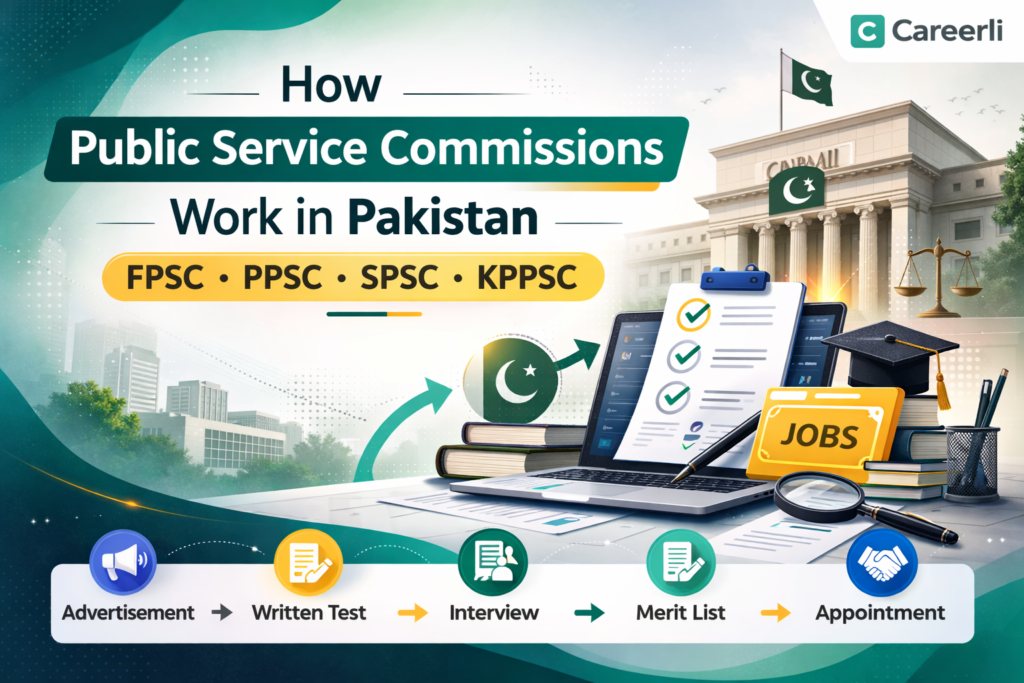
Public Service Commissions play a central role in recruiting candidates for government jobs in Pakistan. Whether you are applying for a federal ministry position or a provincial department vacancy, chances are that the recruitment process is managed by a Public Service Commission (PSC). Despite their importance, many candidates do not fully understand how these commissions operate, how selections are made, and what happens behind the scenes after a job advertisement is published.
In this detailed guide, we explain how Public Service Commissions work in Pakistan, how recruitment stages are structured, and what candidates should expect when applying through FPSC, PPSC, SPSC, or KPPSC.
What Is a Public Service Commission?
A Public Service Commission is a constitutional body responsible for conducting transparent and merit-based recruitment for government posts. Its purpose is to ensure that appointments in public offices are made fairly, based on qualifications and competitive examinations rather than favoritism or influence.
Pakistan has one federal commission and separate commissions for each province:
- Federal Public Service Commission (FPSC)
- Punjab Public Service Commission (PPSC)
- Sindh Public Service Commission (SPSC)
- Khyber Pakhtunkhwa Public Service Commission (KPPSC)
Each commission operates independently within its jurisdiction, but the overall structure and recruitment philosophy remain similar.
Federal Public Service Commission (FPSC)
The Federal Public Service Commission handles recruitment for federal ministries, divisions, and departments operating under the Government of Pakistan. Positions advertised through FPSC typically include administrative services, customs, foreign service, federal education posts, and technical positions in federal organizations.
FPSC is also responsible for conducting the Central Superior Services (CSS) examination, which recruits officers for top administrative posts. The commission follows a structured system involving written examinations, psychological assessments (for certain posts), interviews, and final merit lists.
Provincial Public Service Commissions
Provincial commissions perform a similar function but operate at the provincial level.
For example:
PPSC recruits candidates for Punjab government departments such as health, education, police, and revenue services. SPSC manages recruitment for Sindh-based departments, while KPPSC handles appointments in Khyber Pakhtunkhwa.
If you recently reviewed vacancies such as the Regional Blood Centre Shaheed Benazirabad Jobs, you may notice that certain medical or administrative posts in provincial institutions can either be filled directly by departments or routed through a provincial commission depending on the scale and nature of the position.
How the Recruitment Process Begins
The recruitment process usually starts when a government department identifies vacant posts and obtains approval from the relevant authority to fill them. Once approved, the department sends a requisition to the Public Service Commission detailing:
- Name of the post
- Basic Pay Scale (BPS)
- Eligibility criteria
- Experience requirements
- Age limits
- Quota distribution
The commission then publishes an official advertisement on its website and often in national newspapers.
Application Submission Stage
Most commissions now operate through online application systems. Candidates create accounts, fill in educational details, upload documents, and pay application fees through bank challans or digital payment systems.
At this stage, accuracy is crucial. Incorrect information, missing documents, or eligibility mismatches can lead to rejection before the written test stage.
Screening Tests and Written Examinations
For many posts, commissions conduct screening tests consisting of multiple-choice questions (MCQs). These tests are designed to shortlist candidates when the number of applicants is high.
The syllabus typically includes:
- Subject-related questions
- General knowledge
- Pakistan studies
- Islamic studies or ethics
- English language proficiency
- Basic mathematics or analytical reasoning
Higher-level posts may require descriptive papers instead of MCQs.
For technical healthcare roles similar to those announced in Indus Hospital & Health Network Jobs 2026, subject-specific testing often plays a significant role in evaluating professional competence.
Shortlisting Criteria
After the written test, the commission prepares a shortlist based on marks obtained. Only candidates meeting the required cutoff score are invited for interviews.
Shortlisting is strictly merit-based and follows quota distribution rules, including provincial, regional, women, minority, and disability quotas where applicable.
Interview Stage
The interview stage evaluates a candidate’s communication skills, professional understanding, and suitability for public service. Panels typically consist of commission members and subject specialists.
Questions often focus on:
- Educational background
- Job-specific knowledge
- Current affairs
- Situational problem-solving
- Professional ethics
Interview marks are added to written test scores to determine final merit.
Preparation of Merit List
Once interviews are completed, the commission prepares a final merit list. This list ranks candidates based on cumulative performance.
Appointments are recommended strictly according to merit position and quota distribution. The commission sends recommendations to the concerned department, which then issues appointment letters.
Role of Quota System
Public Service Commissions strictly follow quota policies defined by federal and provincial governments. These may include:
- Provincial quota (for federal posts)
- Regional quota (within provinces)
- Women quota
- Minority quota
- Disability quota
Quota distribution ensures representation from different regions and communities.
Transparency and Accountability
One of the primary objectives of Public Service Commissions is transparency. Written test results, interview schedules, and final recommendations are publicly displayed on official websites.
Candidates who feel unfairly treated may file representations according to prescribed procedures.
Common Misconceptions About PSC Recruitment
Many candidates believe that influence or references play a role in commission-based recruitment. In reality, the structured written examination system significantly reduces the possibility of favoritism.
Another misconception is that once a test is cleared, selection is guaranteed. In truth, final selection depends on combined written and interview performance.
How to Improve Your Chances
Success in commission-based recruitment requires preparation, patience, and accuracy. Candidates should:
- Study official syllabus carefully
- Review past papers
- Stay updated with current affairs
- Prepare for structured interviews
- Ensure application forms are correctly filled
Understanding how the system works gives candidates confidence and realistic expectations.
Final Thoughts
Public Service Commissions in Pakistan — FPSC, PPSC, SPSC, and KPPSC — serve as pillars of merit-based recruitment in the public sector. Their structured processes ensure fairness, transparency, and equal opportunity for candidates across the country.
By understanding each stage of recruitment — from advertisement to final merit list — applicants can prepare strategically and avoid common mistakes. Whether you are applying for administrative services, healthcare roles, technical positions, or education department vacancies, knowing how the commission operates allows you to approach the process with clarity and confidence.
Always verify final details from official commission websites before applying, and prepare consistently to improve your competitive standing.