
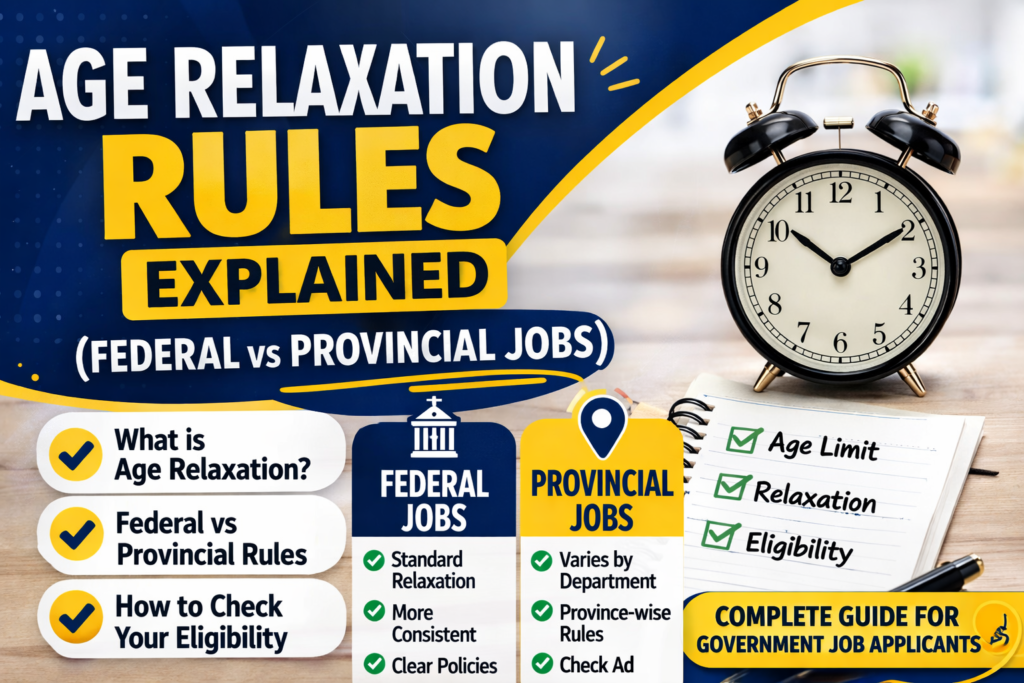
If you have ever applied for a government job, you have probably noticed strict age limits mentioned in job advertisements. But what many candidates don’t fully understand is that these limits are not always final. In many cases, age relaxation is available — but the rules depend on whether the job is federal or provincial.
This confusion causes many applicants to either miss good opportunities or apply incorrectly. Some candidates assume they are overage when they are actually eligible, while others apply without meeting the relaxation criteria and get rejected early. This guide explains everything in a simple, practical way so you can avoid these mistakes.
What is Age Relaxation?
Age relaxation means extra years added to the maximum age limit mentioned in a job advertisement. For example, if a job has an upper age limit of 30 years, age relaxation may allow certain candidates to apply up to 33, 35, or even more depending on their category.
However, one important thing to understand is that age relaxation is not the same for everyone. It depends on your background, category, and the type of job you are applying for.
Why Age Limits Exist in Government Jobs
Before understanding relaxation, it helps to know why age limits are set in the first place. Government departments define age limits to maintain a balance between fresh candidates and experienced individuals. Younger candidates are often preferred for long-term service, while some roles require maturity and experience.
Age relaxation is introduced to create fairness, especially for candidates who may have faced delays in education, employment, or other valid reasons.
Federal Government Jobs – Detailed Rules
Federal government jobs usually follow more structured and consistent rules. In most cases, a general age relaxation of 5 years is allowed for all candidates unless clearly restricted.
This means if the age limit is 30 years, most applicants can apply up to 35 years.
In addition to this general relaxation, extra relaxation may be granted in specific cases:
- Government employees with relevant service
- Candidates from certain regions or backgrounds
- Special categories defined in federal policies
The advantage of federal jobs is clarity. Most advertisements clearly mention the relaxation policy, and the rules are usually consistent across departments.
Provincial Government Jobs – More Variation
Provincial jobs are different. Each province has its own policies, and even within the same province, rules can vary from department to department.
In provincial hiring:
- Some jobs allow general relaxation, others do not
- Rules may change depending on the department
- Advertisements must be read very carefully
For example, in Punjab, certain departments provide relaxation similar to federal jobs, while others strictly follow the mentioned age limit without any flexibility.
This makes provincial jobs slightly more confusing for applicants.
Federal vs Provincial – Simple Comparison
- Federal Jobs: More predictable, usually include standard age relaxation
- Provincial Jobs: Less predictable, rules vary by department
If you are applying for federal jobs, you can expect some level of consistency. But for provincial jobs, you must check each advertisement individually.
Category-Based Age Relaxation
Age relaxation is often linked to specific categories. While exact categories vary, commonly included groups are:
- Existing government employees
- Candidates from underrepresented areas
- Special or reserved categories defined by policy
Each category has its own conditions. Simply belonging to a category is not enough — you must also meet the required criteria.
Real-World Example
Let’s say a job has an age limit of 30 years:
- A general candidate may apply up to 35 years (with 5-year relaxation)
- A government employee may get additional years depending on service
- A candidate without any eligible category may not get relaxation at all (in some provincial jobs)
This is why assumptions can be risky. Always verify based on the specific job.
Common Mistakes Candidates Make
Many applicants lose opportunities due to simple misunderstandings:
- Assuming everyone gets 5 years relaxation automatically
- Not reading the advertisement carefully
- Ignoring category-specific conditions
- Applying while clearly overage without valid eligibility
These mistakes often result in rejection at the initial screening stage.
How to Check Your Eligibility Step-by-Step
Before applying for any job, follow this simple process:
- Check the maximum age limit mentioned
- Look for age relaxation details
- Identify your category (if applicable)
- Calculate your age on the closing date
- Confirm eligibility before submitting the application
This small effort can save you from rejection and wasted time.
Does Age Relaxation Guarantee Selection?
No. Age relaxation only allows you to apply — it does not increase your chances of selection.
Government jobs are highly competitive. Even if you qualify through relaxation, your test performance, qualifications, and experience will determine your success.
This is especially true for technical and policy-level roles like those in
National Tariff Commission (NTC) Jobs 2026
, where expertise matters more than eligibility alone.
When Age Relaxation May Not Be Available
There are situations where age relaxation is limited or not allowed at all:
- Highly specialized or technical roles
- Contract-based positions
- Jobs with clearly fixed upper age limits
If a job advertisement clearly states “no age relaxation,” then exceptions are usually not considered.
Practical Advice for Candidates
Instead of depending only on age relaxation, focus on long-term planning:
- Apply early in your eligible years
- Prepare seriously for tests and interviews
- Improve your qualifications and skills
- Stay updated with job announcements
Age relaxation should be seen as a backup option, not a primary strategy.
Final Thoughts
Understanding age relaxation rules can give you a clear advantage in government job applications. Federal jobs are generally more consistent, while provincial jobs require closer attention to detail.
The key is simple — never assume. Always read the advertisement, verify your eligibility, and apply with confidence.
In the end, eligibility allows you to enter the competition, but preparation is what helps you win it.